
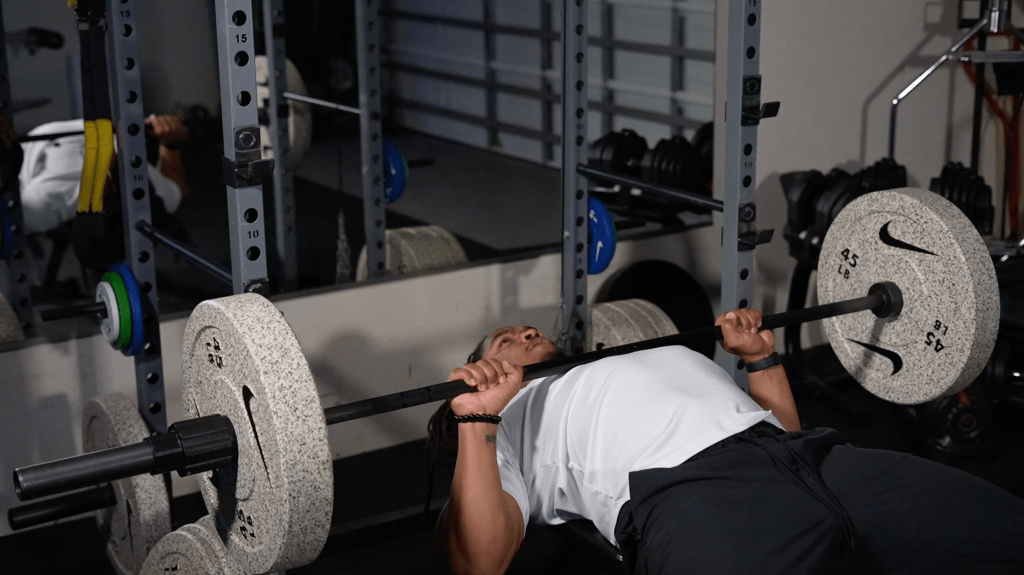
One of the most fundamental strength training exercises for the upper body is the bench press.
Bench pressing helps develop strength and build muscle mass in the upper body, particularly in the chest, shoulders, and arms.
The bench press primarily works the pectoralis muscles, which are the chest muscles, the triceps, and the anterior deltoids, which are the muscles in the front of the shoulder. However, other muscles are also involved in the movement, including the muscles that help the shoulder blades move, the latissimus dorsi (or the lats), the rhomboids and traps in the upper back, and core muscles.
When bench pressing, it’s important to maintain proper form and technique to prevent injuries. You should also gradually increase your weight. These are things a certified personal trainer can assist you with.
Proper Bench Press Technique
When you set up to bench press, lie flat on your back on the bench and plant your feet on the ground. Your head should be positioned so that your eyes are directly underneath the barbell. This aligns your shoulders properly and prevents the barbell from hitting the rack as you perform reps.
Your grip on the barbell should be a little wider than shoulder-width apart, and your hands should feel like you’re attempting to bend the barbell.
As you prepare to begin benching, retract your shoulder blades and make sure you have a small arch in your lower back. The bar should come down and tap near the nipple line in the mid-chest area. Keep your elbows at approximately 45-degree angles to prevent shoulder strain.
When you press up with the barbell, exhale and fully extend the arms, but do not lock out your elbows. This will engage the chest, triceps, and shoulders.
What Not To Do While Bench Pressing
Performing any exercise with poor form and technique can result in injury, including bench press.
When benching, make sure you always warm up properly. At Uno’s Fitness, we have a dynamic warm-up that our clients use each day, including the use of an exercise band to warm up the chest and upper body. You should also use a spotter when benching, especially when benching heavy weights. A personal trainer can serve as your spotter.
Make sure you control the weight and perform the exercise in a smooth motion. To assist with this, don’t attempt to increase weight too fast.
Here are some other tips to avoid injury when bench pressing:
- Don’t flare the elbows too wide, keep them at approximately 45-degree bends to prevent shoulder strain.
- Don’t lift your feet off the ground or excessively arch your back.
- Don’t bounce the bar off the chest. Control the movement of the bar.
- Go through the full range of motion. Failure to do so limits your strength gains.
- Maintain proper alignment in the wrists, shoulders, and elbows.
- Strengthen the supporting muscles in your shoulders, triceps, upper back, and core.
How a Personal Trainer Can Help You
If you’re new to bench pressing or want to see gains faster, a certified personal trainer at Uno’s Fitness can help you.
A personal trainer can identify poor form and areas where you may be compensating for weakness, which can lead to injury or minimal gains from bench pressing. Personal trainers will also serve as your spotter, make sure you are safely progressing when increasing weight, and personalize a plan to help meet your goals.
There are variations of bench pressing that a personal trainer can introduce to help target certain parts of the chest and upper body, such as close and wide grips, incline and decline bench, dumbbell bench press, and more.
Reach out Uno’s Fitness today to set up a free consultation and we will help you reach your health and fitness goals.






Leave a comment