
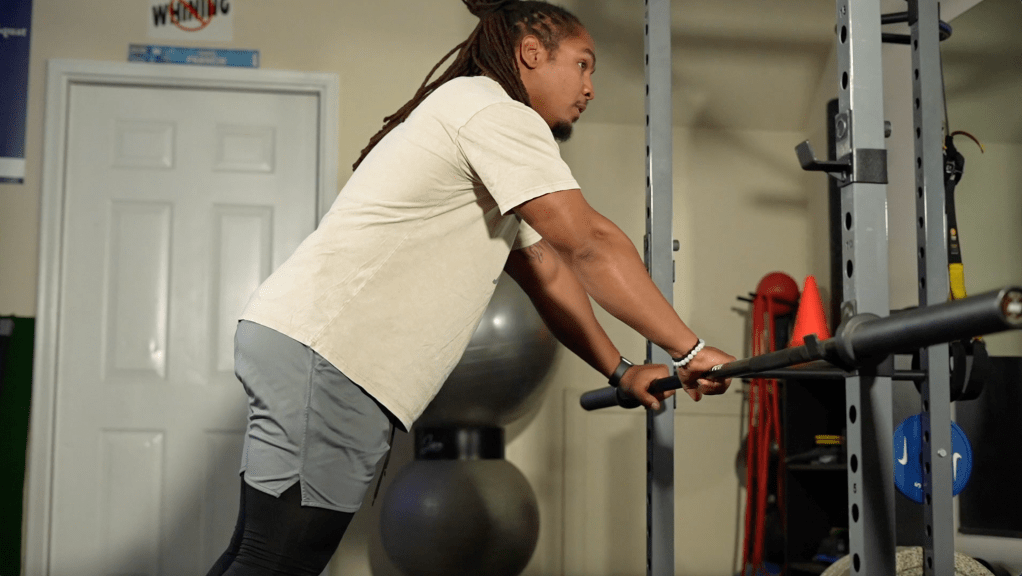
Chest-supported rows are a variation of barbell rows, so many of the same muscles are worked, and the motion is generally the same.
Like barbell rows, chest-supported rows target the latissimus dorsi (the lats, which help with pulling motion), the rhomboids (which help with movement of the shoulder blades), and the trapezius (or the traps, which help stabilize the shoulder blades).
However, there are some differences between chest-supported rows and barbell rows. If you’re a beginner, coming back from an injury, struggling to maintain proper form, or want better to target your upper back muscles, chest-supported rows could be for you.
How to do chest-supported rows
Chest-supported rows are precisely what they sound like: rows performed while your chest is supported. This isolates the muscles in the upper back, supports the spine, and reduces the risk of injury.
Start by lying face-down on an incline bench, which should be set between 30-45 degrees. The bench should support your stomach, and you should have the balls of your feet firmly on the ground or footrests built into the bench. Your arms will hang in a natural position while you hold the weight, which could be a barbell or a pair of dumbbells.
To begin the movement, squeeze your shoulder blades together and pull the weight towards your abdomen. The goal is to tap underneath the bench using a barbell, then lower the weight back to the starting position in a controlled manner.
Chest-supported rows vs. Barbell rows
Chest-supported rows and barbell rows have the same general movement and target most of the same muscles. They are not the same exercise though.
When doing chest-supported rows your chest lies flat against an incline bench instead of hinging at the hips, which requires you to support the weight of the barbell through the motion. This leads to a different result for chest-supported rows.
- Chest-supported rows reduce the weight load on your spine, while barbell rows require your lower back and core to be more engaged. If you’re dealing with a spinal injury, weak core muscles, or struggle to maintain correct form, chest-supported rows could be a better option for you.
- Using the bench makes maintaining correct form easier, whereas barbell rows require more core activation and control of the weight.
- People can use the momentum of body movement while doing barbell rows, which reduces the effectiveness of the exercise. However, when doing chest-supported rows, there is no momentum to take advantage of. This means the exercise may be more efficient.
- Chest-supported rows isolate the muscles in the upper back more than barbell rows, so if you’re looking to specifically target the lats, the traps, and the rhomboids, chest-supported rows could be a good option.
- Chest-supported rows are a great way for beginners to start because the risk of injury is lower and the movement is less technical than barbell rows. Over time, as muscles are strengthened, and with the guidance of a personal trainer, beginners can move on to more difficult exercises and movements.
Let Uno’s Fitness help you
Wherever you are in your fitness journey, Uno’s Fitness is ready to help you.
Are you looking to incorporate rows into your workout routine? Working with a certified personal trainer, you will get one-on-one coaching to ensure you’re doing the exercises that will benefit you most. If you’re dealing with an injury or need help with technique, chest-supported rows may be for you. A personal trainer will make sure you’re doing the exercise correctly and will help you progress towards other movements.
Contact Uno’s Fitness today to set up your free consultation.






Leave a comment