Your shoulder is an important joint for many different activities, sports, and upper body function, so any pain or immobility can impact many aspects of your day-to-day life.
The shoulder is a ball-and-socket joint, which includes the humerus (upper arm), scapula (shoulder blade), and clavicle (collarbone) bones. The bones work with your rotator cuff muscles, deltoid, trapezius, rhomboids, and pectoralis muscles.
These muscles and bones allow for raising and lowering the arm, moving the arm away from and toward the body, twisting and rotating the arm, and moving the arm in a circular motion.
If you’re experiencing pain in your shoulder, recovering from an injury, or hoping to prevent a repeat injury, a personal trainer can help create a customized plan to address your specific needs.
Shoulder Recovery & Rehab Exercises
These are some of our favorite exercises to help rehab a weak or injured shoulder. These exercises consist of two main movements: internal and external rotation.
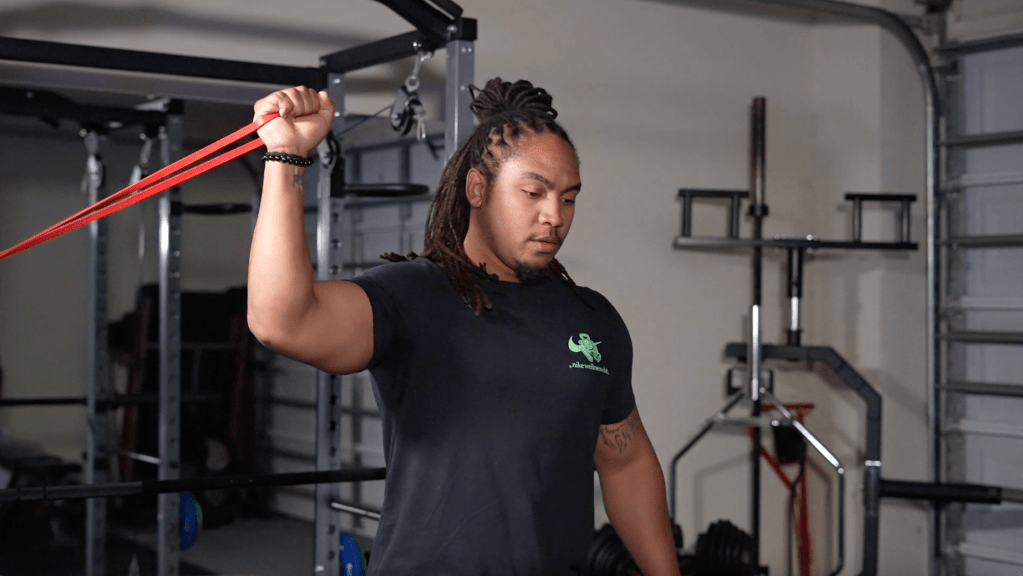
Grab an exercise band and tie it to any kind of post. You will do these exercises with your elbow by your side and your hand at elbow height.
- Keep the distance between your elbow and your side minimal. Rotate towards your belly button to get internal rotation.
- To do external rotation, start at your belly button and rotate away.
Next, you will hold the band in your hand and lift your elbow so that it is shoulder height. Make sure the band has been moved up on the post so it is also at shoulder height.
- With the band in line with your forearm, rotate your arm forward. Keep your elbow high at shoulder height as you rotate, don’t let your elbow drop.
- For external rotation, turn around to face the band, start with your arm in the forward position and rotate your arm upwards and toward your back. Don’t let the elbow drop.
Doing these different range of motion exercises will help strengthen the ligaments in your shoulder.
Shoulder Recovery Tips
If you’re dealing with shoulder issues, it may be necessary to see a doctor or physical therapist. Doctors can do imaging tests to determine what exactly is going on with your shoulder. A personal trainer can aid in your recovery once you get a diagnosis though.
Here are some other tips that can help you with shoulder recovery:
- Avoid activity that makes your shoulder pain worse. Modify exercises or movements if necessary, or take a break.
- When you return to exercise, do so gradually and be sure you’re using proper form.
- Ice and cold therapy can help reduce inflammation if you’re experiencing swelling.
- Heat therapy can help improve blood flow and loosen muscles, but be careful using heat if you’re experiencing inflammation because it can make it worse.
- Whether you’re working with a personal trainer or a physical therapist, make sure you are doing your recovery exercises regularly.
Need help?
With a degree in Exercise & Sports Science and with certifications as a personal trainer and a strength & conditioning specialist, Khris Francis and Uno’s Fitness are ready to help you in your shoulder recovery journey.
Uno’s Fitness will develop a personalized plan for you. We can also incorporate the plans you get from your doctor or physical therapist.
Reach out to Uno’s Fitness today to set up a free consultation.





Leave a Reply