If you aim to improve power, explosiveness, and athletic performance, few exercises compare to cleans and hang cleans.
Cleans are an Olympic lift that builds strength, speed, and coordination. Cleans and hang cleans are helpful for people who are training for a sport, but also for people who want to level up their fitness.
Power is required for cleans and hang cleans. In fitness, power refers to the body’s ability to quickly create force, moving weight with speed and control.
How a hang clean is different than a clean
Cleans, sometimes known as power cleans, have many similarities with hang cleans, but they are different exercises.
The biggest difference between cleans and hang cleans is the positioning. A clean starts from the floor, while a hang clean starts in a standing-ready position, which is also called a hinged position.
Cleans require two pull phases:
- First Pull: From the ground to a standing-ready position.
- Second Pull: From the ready position to the catch position.
Hang cleans starts in the standing-ready position and only has one pull, which ends in the catch position.
How to perform a clean or hang clean
There are three positions you need to know for a clean and two for a hang clean.
Pull Phase 1: Ground Position (cleans only)
Setting up for a clean requires you to start in the ground position. This is similar to how you set up for a deadlift. The first pull phase is essentially a deadlift at a high rate of speed as you keep the bar close to your body.
- Feet should be positioned hip-width apart
- Grip on the barbell should be slightly wider than hip-width
- Hips should be lower than your shoulders as you hinge at the hips and push the butt back
- Roll the barbell so it touches the shins
- Keep the back flat, chest up, and shoulders retracted
- Make sure your core is engaged
As you finish the first pull phase, you enter the second pull phase.
Pull Phase 2: Ready Position (start of a hang clean)
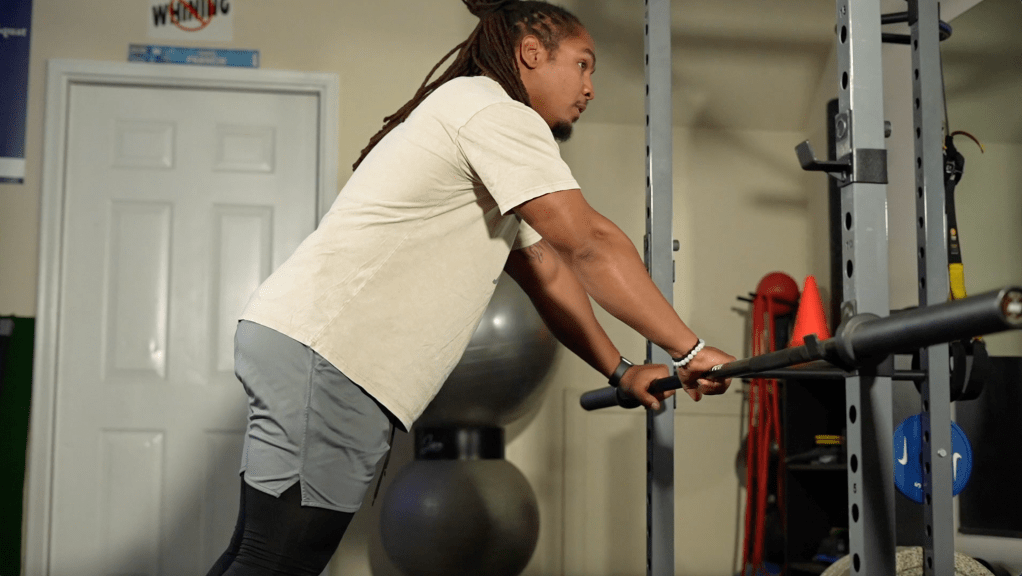
The second pull phase starts with you extending from your hips and ankles from the ready position and shrugging to get the bar moving at a high speed. Then you will pull the barbell vertically with your arms, driving your elbows to the ceiling. The barbell remains close to your body throughout the movement.
- Keep your feet hip-width apart, the grip wider than the hips, and knees slightly bent.
- Continue to hinge at the hip by pushing the butt back.
- The spine should remain neutral, with the back flat, chest out, and shoulders retracted
- Core remains engaged as the bar is just above the knees and in contact with the quads
Phase 3: Catch Position
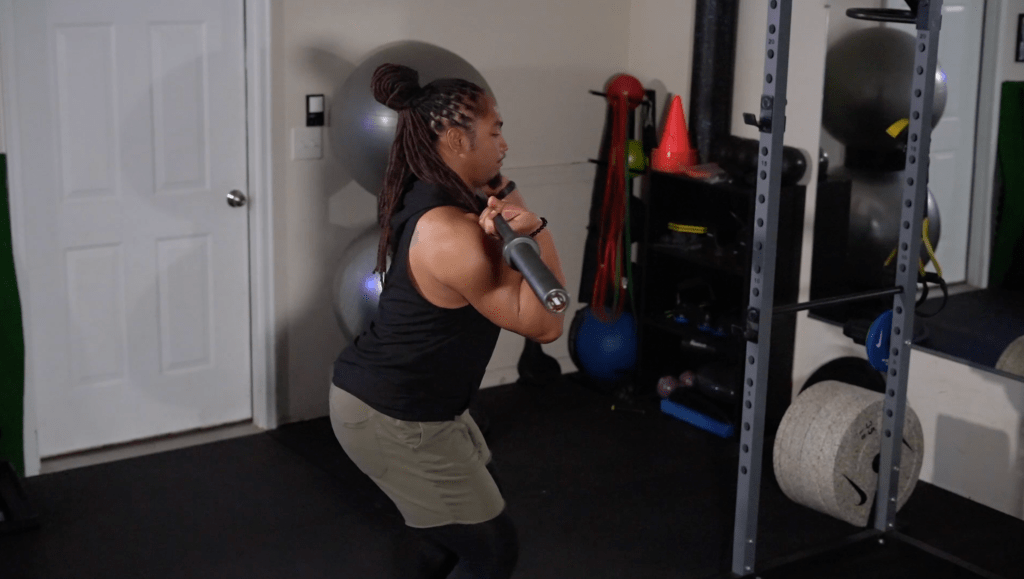
As the barbell elevates, you want to pull your body under the barbell and flip your wrists and elbows underneath and forward, allowing you to catch the barbell across your collarbone in a slight squat. Finish the movement by standing tall.
- With the feet still hip-width apart, the elbows point forward, and the bar rests across the front of the shoulders near the collarbone.
- Wrists should be rotated underneath the barbell
- You will find yourself in a slight squat position on the catch, but stand tall to finish.
Benefits of cleans and hang cleans
Cleans and hang cleans deliver real performance results for athletes and for people who are looking to improve their fitness levels.
- Full-body exercises: These exercises work your glutes, hamstrings, quads, back, shoulders, and core.
- Explosiveness: Because cleans and hang cleans focus on power and speed, they are great for athletes who run, jump, or need to be able to change direction quickly.
- Coordination: With multiple components to the movement, cleans and hang cleans help with coordination and timing.
- Calories: Cleans and hang cleans are high-intensity movements that help burn calories and can be part of someone’s weight loss journey.
- Athletic performance: Cleans and hang cleans help build muscles that are needed for sprinting, jumping, and explosiveness.
If you are new to weightlifting or have never done cleans and hang cleans, you should be cautious as you introduce this exercise. Start with something light, perhaps just the barbell itself, before you increase the weight load. Make sure you have mastered the form and technique of the movement before you add weight.
Let Uno’s Fitness help you
If you’re interested in adding cleans and hang cleans to your workout routine, we suggest you work with a certified personal trainer to make sure you’re safely doing them.
If you use improper form, there is a risk of injury. A certified personal trainer at Uno’s Fitness will make sure you have proper mechanics and are safely increasing weight.
Contact us today to set up your free consultation and we’ll help you get started right away.





Leave a Reply